Helen Kerrige
2024 Featured Artist
Auction Price $40,000


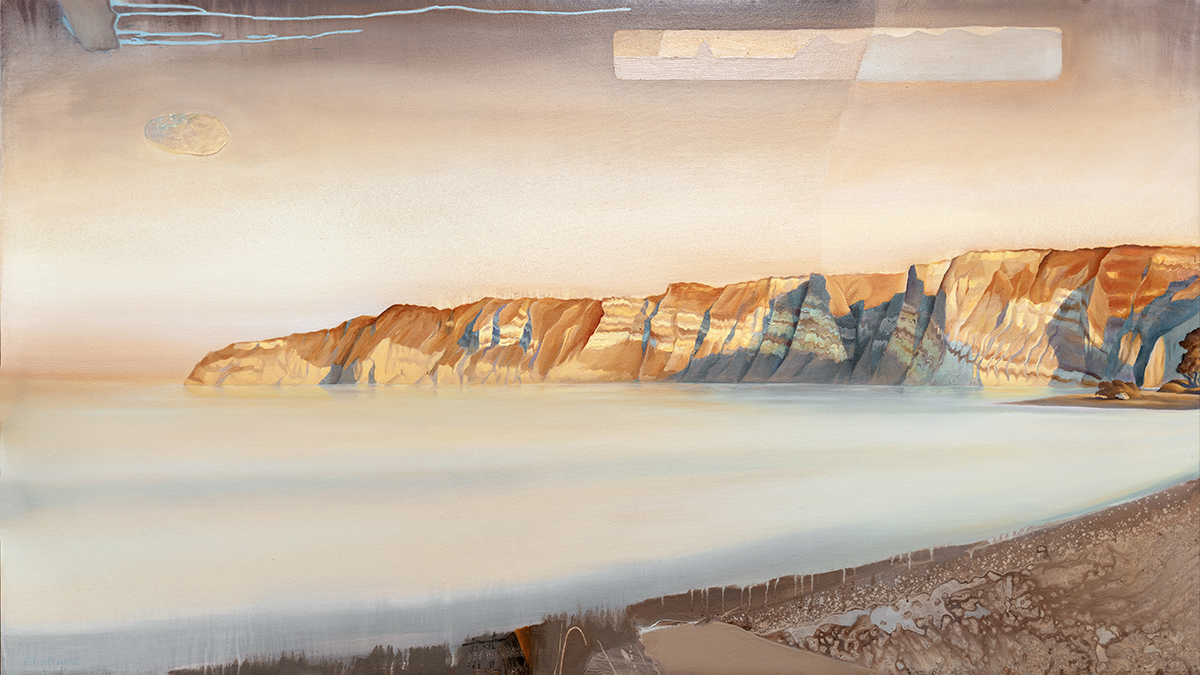
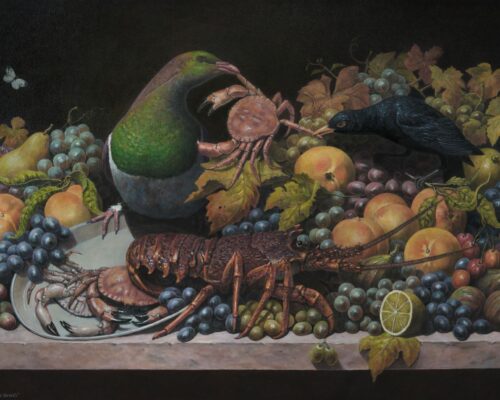
Auction Price $40,000
Helen’s forty year career spans across work as an artist, photographic retoucher, illustrator, and arts tutor. Her work, known for its meticulous precision and deep symbolism, has been featured in both private and public collections throughout New Zealand.
She began her career as a teenager at a professional photographic printing laboratory in Auckland, pre-computers and Photoshop, where seamless artwork was manually implemented to alter images. Her early career took her to America where she specialised in retouching portrait photographs for exhibitions. The importance of flawlessly altering prints later led to the development of her photo-realism.
Throughout her career Kerridge has worked in a variety of genres including Cubism, Impressionism, and landscape painting. She spent time in Florence studying portraiture in the sight size technique of John Singer Sargent. Of the many areas she has delved into, still life continues to resonate and return to her oeuvre.
Painting in both acrylics and oils, Helen is well known for her photo-realism work. She also creates imaginative still life pieces inspired by the Old Dutch Masters, featuring Kereru feasting on tables laden with produce
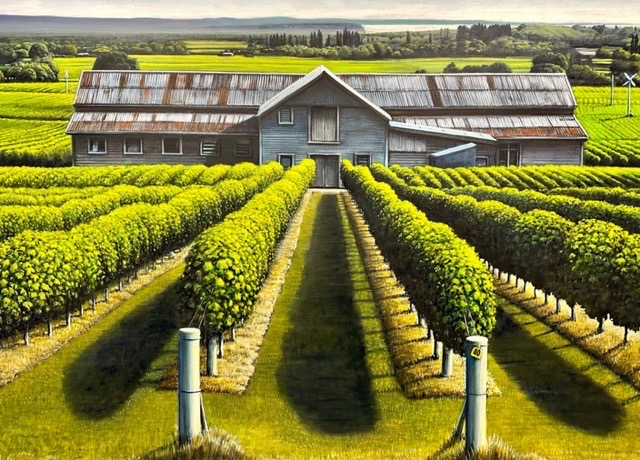
Auction Price $44,000
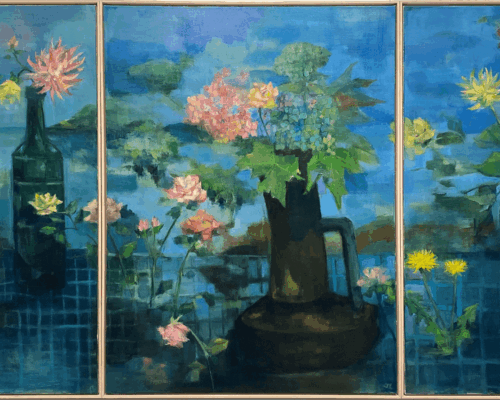
Auction Price $20,000
John Lancashire is a contemporary New Zealand painter living in Hawke’s Bay, also known as Monday Painter.
John has been an artist for 20 years, over the past 10 years, he has built a reputation as a serious artist. Working in fine oils on canvas, Lancashire specializes in expressionist still life works imbued with character.
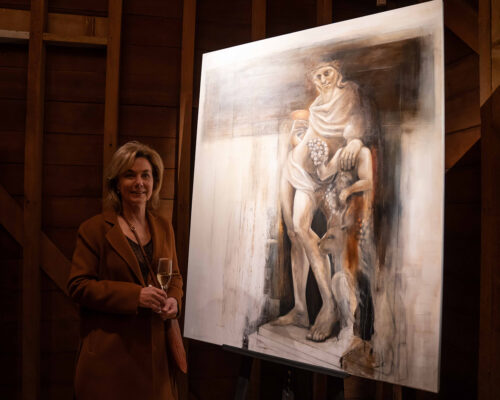
Anna is a contemporary artist, born and raised in Hawkes Bay of Ngai Tahu and Danish descent. She has been painting for well over two decades, painting has been part of her life as long as she can remember.
Initially inspired by attending art classes and completing a Fine Arts Diploma in painting and drawing in 2002. Stepping back after 26 years in business, Anna has been fortunate to be able to focus fully on her art, spending the last four summers studying painting in Italy. Whilst there Anna was able to paint alongside some of Europe’s best tutors. Anna is heading to New York later in the year to continue her studies.
“I am delighted to be selected as the 2020 Hawkes Bay Wine Artist and look forward to designing and creating a painting that is fitting and reflective of this special event and our beautiful region.” “working along-side these passionate and generous people who unselfishly create this incredible event each year is an honour, as is being able to give back and create a piece of artwork with proceeds to Cranford, most of us have been touched by their support and strength when faced the loss of a loved one.”
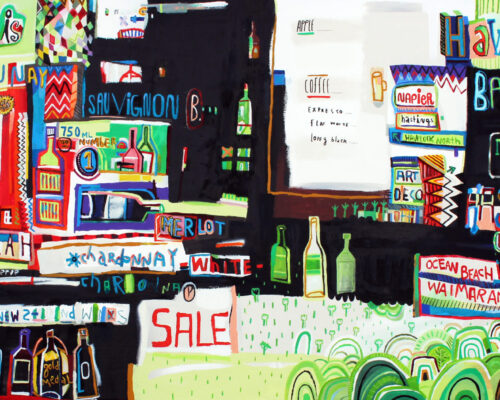
Born in 1977 in Sao Paulo (Brazil), Mauricio Benega moved to New Zealand in 2004 and now lives and works as a full time artist in Hastings.
Mauricio graduated with a Bachelor Degree of Visual Arts & Computer Graphics in 2001 at University of Tuiuti Parana, Brazil. He also completed a Post-Graduation in School Administration & Visual Arts in 2004 at FAE Business School in Curitiba, Brazil and a Diploma of Visual effects & Motion Graphics in 2009 at Media Design School in Auckland, New Zealand.
Working from his studio based in Hastings, he opened a business named Studio Benega Ltd, a creative company dealing with creative art projects, such as; exhibitions, murals, workshops, illustrations, design, commissions and paintings.
He loves to Work on different projects, especially commissions (when the client gives the brief for a painting or a mural). He really enjoys the process of digesting all the information and creating a beautiful composition that tells this story through images, icons and layer upon layer of texture and colours.
As part of this process, he created the FAS System, which stands for Family – Art – Surf – These 3 elements are the completed cycle that defines him and keeps him inspired and motivated to produce every day, unless surf is up, then he’s out.
The Hawke’s Bay community is familiar with his work from such murals as Clive Pool, the Opera House 100 years celebration fence mural and The Hastings Menu, in the Alleyway of Market street, commissioned by the Hastings District Council.
Mauricio’s work can be found in collections in NZ, Brazil, Australia, Italy, Portugal, Switzerland, Germany, USA, Indonesia and Singapore.
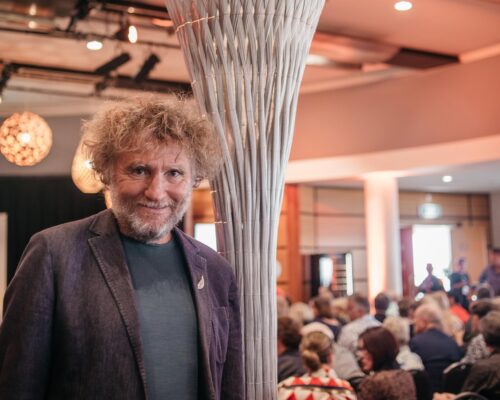
David’s work came to prominence in 2001 when the Italian design house Cappellini bought the rights for Body Raft. The Coral light followed in 2004 for DTL, establishing a blueprint for kit-set products that minimised environmental footprint. The company is proud to hold Life Cycle Assessments (LCA’s) and Environmental Product Declarations (EPDs).
David’s designs have featured in countless international publications including the most influential, as an instigator of the trend of ‘raw sophistication’ and as an exemplar of environmentally responsible design. In 2008 the French magazine Express listed him as one of the top 15 designers in the world, and in 2012 the Pompidou Centre in Paris purchased his ‘Icarus’ installation for its permanent collection.
We were delighted to work alongside one of Hawke’s Bay leading contemporary art galleries, Parlour Projects, and work with the very talented Ben Pearce, who was the 2017 commissioned artist for the 26th wine auction event.
Pearce is an extraordinarily versatile artist and is well respected by the larger art world nationally. He lives and works in Hawke’s Bay but regularly exhibits across New Zealand and internationally.
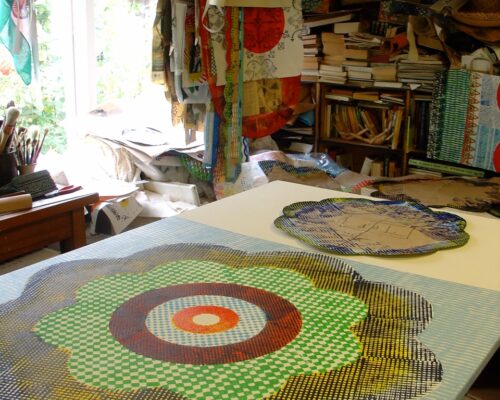
Rather as if the Rococo François Boucher had opened his mouth in a room full of dour olive-green-landscape painters and said, “trop verte et mal éclairée” (too green and badly lit).
Boucher also liked to make stage designs and costumes, as well as designs for tapestries and chinaware; Chilcott designs furniture, carpets and ceramics. It’s true that Madame de Pompadour’s dress in Boucher’s famous portrait of 1756 is a grand floral landscape all by itself, just as it’s true that his stage-managed exteriors (Diana Leaving the Bath 1742) are really interiors—but that’s also where an underlying seriousness appears.
In Boucher’s world, as in Gavin Chilcott’s, the outside and the inside flow, in and out of each other, across an imaginative switcher that redirects the sensuous delights of the natural world into the designed spaces where people live. A sense of abundance and excess is generated; and the organised, well designed pleasures of the artifactual and architectural world into the natural one, where they produce a sense of calm and reflection. There’s also, of course, a cross-transfer and mash-up of an interior mental world and an exterior physical one: a place of surrealist play and occasional unease. This transfer is a serious and indeed responsible business: at heart Chilcott’s work is about respect for those phenomena that give us pleasure.
Time and again his deployments of materials (paper bags anyone?), colours (a garden designed around seasonal colour fields) and narratives (the humour and pathos of the ‘autoportrait’ series in the late 1980s) disclose a mandala-like diagram of consciousness mapping the precious connections between pleasure, knowledge and care, presided over by a marvelous sense of humour.
Ian Wedde
29 March 2016
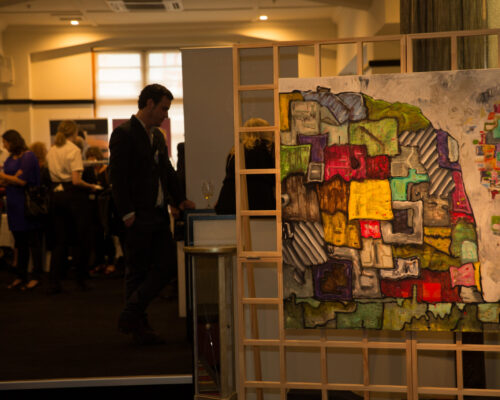
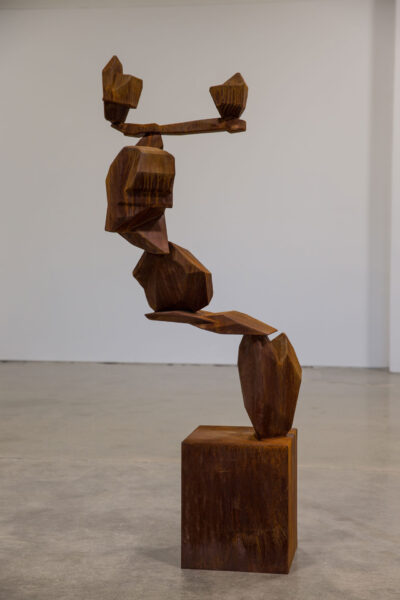
Martin’s studio is ‘plop on top of Bluff Hill’, and he challenges himself to use form from his immediate environment. “From here, I often look to the edges of the Bay, the top-end being Portland Island and Mahia, while at the bottom end is Cape Kidnappers. Within these locations sits a community served largely by horticulture, agriculture, and most significantly, by culture and ideas.”
According to Martin, this artwork emerged from considering the aspects of simply being here. “The title Portland came from the idea of requiring sanctuary or harbour when conditions may be rough, or simply as a means of passage”, he says. A sentiment that also encapsulates the Cranford Hospice environment and mission.
“One would like to think that the artwork resonates with the fact of being present.”